
Summary: Accessibility encompasses all disabilities and differences, including: but not limited to vision, hearing, motor, speech, and cognitive. Disabilities can affect anyone at any time, be visible or invisible, and be permanent, temporary, or situational.
Overview
Accessibility encompasses all disabilities and differences, including: but not limited to vision, hearing, motor, speech, cognitive, and more. Disabilities can affect anyone at any time, be visible or invisible, and be permanent, temporary, or situational.
Image description: Illustrations depicting permanent (including one arm, blindness), temporary (including ear infection, laryngitis), and situational disabilities (including heavy accent, distracted driver).
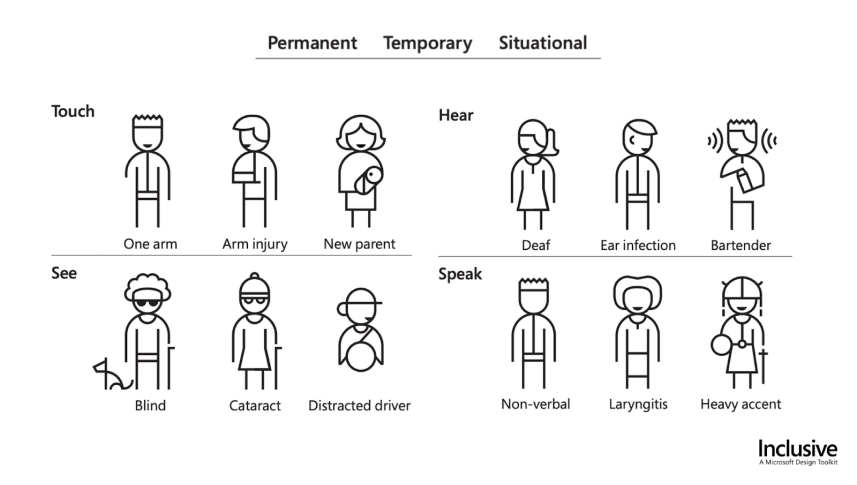
Image sourced from the Microsoft Inclusive Design Toolkit
Get involved with The Disability Alliance at Google
The Disability Alliance (DA) is an Employee Resource Group for Google/Alphabet employees who care about disability, learning differences, or neurodiversity. They share advice, advocate, and build awareness, and are passionate about creating innovative and inclusive teams, products, education, and workplaces.
Want to learn more about disabilities?
Get the FAKC
Learn more about disabilities and differences by completing the Foundational Accessibility Knowledge Certificate (FAKC)
Disability Statistics
Review recent statistics about disabilities across the world at go/disability_stats
There’s No Such Thing as Average
Read an article by Todd Rose on Brain Science and the Limitations of Standards
Up next
Continue on to learn about five primary categories of disabilities and differences. This will help you understand who benefits from accessibility and why it's so important.